
SSS Pension Requirements for Voluntary Members in Philippines

Voluntary members can qualify for an SSS monthly retirement pension just like employed and self-employed members. The key requirements are your age, contribution history, retirement status, and the number of valid contributions posted to your SSS record.
For most voluntary members, the most important requirement is:
At least 120 monthly contributions paid before the semester of retirement.
If you have fewer than 120 contributions when you reach retirement age, you may still have the option to continue paying as a Voluntary Member until you complete the required 120 contributions instead of immediately receiving a lump-sum retirement benefit.
This guide explains the 2026 SSS pension requirements for Voluntary Members, current contribution amounts, age requirements, missed contributions, changing your Monthly Salary Credit, applying for retirement, and what happens if you have fewer than 120 contributions.
If you already know your contribution history, you can use our SSS Pension Calculator to estimate your potential retirement benefit.
Who Is an SSS Voluntary Member?
An SSS Voluntary Member (VM) is generally someone who was previously covered by SSS as:
- an employee;
- a self-employed member; or
- an Overseas Filipino Worker (OFW);
and has at least one valid posted SSS contribution from that previous coverage.
The person is no longer working or earning under that previous membership category but chooses to continue paying SSS contributions voluntarily to maintain eligibility for future benefits.
This distinction is important.
Having an SS Number alone does not automatically allow someone to start paying as a Voluntary Member.
If you obtained an SS Number but have never had a valid contribution posted as an employee, self-employed member or OFW, you generally cannot simply choose “Voluntary Member” for your first contribution.
SSS states that a Voluntary Member should already have an established date of coverage from previous qualified membership.
Do I Need to Register Separately as a Voluntary Member?
Usually, no separate registration form or supporting document is required when an eligible member switches from employee, self-employed or OFW coverage to Voluntary Member status.
When generating your Payment Reference Number (PRN) through My.SSS or the SSS Mobile App, select:
Voluntary Member
as the membership type.
Paying the contribution using the appropriate membership type serves as the declaration that you are no longer paying as an employee, self-employed member or OFW for that contribution period.
However, only use Voluntary Member status if you genuinely meet the SSS conditions for that membership type.
Can Voluntary Members Receive an SSS Pension?
Yes.
Being a Voluntary Member does not prevent you from qualifying for an SSS retirement pension.
A Voluntary Member who satisfies the applicable retirement requirements can receive the same type of regular SSS retirement benefit available under the Social Security program.
Depending on your record, that may be:
Monthly retirement pension
or
Lump-sum retirement benefit
The most important difference is whether you have completed the required 120 monthly contributions before the semester of retirement.
SSS Pension Requirements for Voluntary Members
For most Voluntary Members, the important requirements are:
1. Meet the Retirement Age Requirement
For ordinary SSS members, retirement is generally divided into optional and technical retirement.
Optional retirement: beginning at age 60, subject to applicable work-status requirements.
Technical retirement: beginning at age 65, regardless of whether the member is still employed or otherwise working, subject to SSS rules.
Special retirement ages apply to certain occupations such as qualified mineworkers and racehorse jockeys.
2. Have at Least 120 Monthly Contributions
To qualify for a regular monthly SSS retirement pension, the member generally needs:
120 monthly contributions prior to the semester of retirement.
This is equivalent to 120 contribution months.
Mathematically, 120 months equals 10 years, but it does not mean you must have exactly 10 uninterrupted years of employment.
For example, you could have:
- 48 contributions as an employee;
- a two-year gap;
- 36 contributions under another employer; and
- 36 contributions as a Voluntary Member.
Your total would be:
48 + 36 + 36 = 120 contributions
The contribution history can come from different qualified stages of your SSS membership.
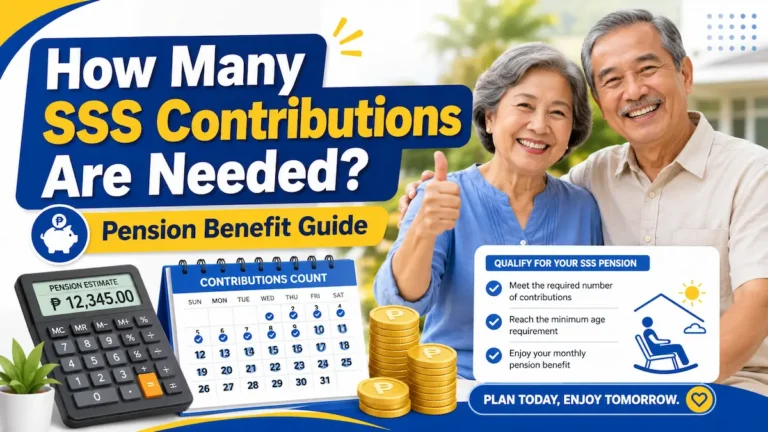
For a detailed explanation of this rule, see our guide on how many SSS contributions are needed to receive a pension.
3. Make Sure the Contributions Are Properly Posted
Do not rely only on receipts or your own calculation.
Before retirement, check your My.SSS contribution record and verify that the expected contributions are actually posted.
Missing or incorrect contribution records should be addressed before filing your retirement claim.
What If I Have Fewer Than 120 Contributions?
This is one of the most important rules for Voluntary Members.
If you reach retirement age with fewer than 120 qualifying monthly contributions, SSS gives you the option to continue paying as a Voluntary Member until you complete the required 120 contributions.
You do not necessarily have to take the lump-sum benefit immediately.
Example: 115 Contributions
Suppose you reach retirement age with:
115 contributions
You are:
5 contribution months short
You may choose to continue paying voluntarily until you complete the qualifying contribution requirement, subject to the applicable SSS rules.
Example: 90 Contributions
If you have:
90 contributions
you would need:
30 additional contribution months
to reach 120.
Whether continuing contributions is the right choice depends on your age, financial circumstances and retirement plans.
What If I Don’t Continue to 120?
If you qualify for retirement but have fewer than 120 contributions and do not continue paying until you reach 120, you may qualify for the applicable one-time lump-sum retirement benefit.
This is different from receiving a monthly pension for life.
Before making that decision, check your actual contribution count and verify your options with SSS.
Can I Continue Paying SSS After Age 60?
Yes, in applicable circumstances.
SSS specifically states that a member who is 60 or older but not yet 65, and already has 120 or more contributions, may continue paying as a Voluntary Member until age 65 to avail of full benefits.
This means reaching age 60 does not necessarily force you to stop contributing immediately.
You may decide to continue contributions instead of filing for optional retirement right away.
Your individual decision should consider your retirement plans, contribution history and financial situation.
Can I Continue Paying After Age 65 If I Have Fewer Than 120 Contributions?
Yes.
This is particularly important for members who began contributing late or had long gaps in their SSS history.
SSS states that a member who is:
65 years old or older
and has:
fewer than 120 contributions
may continue paying as a Voluntary Member until completing the required 120 contributions for monthly retirement-pension eligibility.
So turning 65 does not automatically eliminate the opportunity to complete your 120 contributions.
Can Voluntary Members Pay Missed SSS Contributions?
Generally, no.
A Voluntary Member cannot simply go back several years and pay old missed months to fill gaps in the contribution history.
SSS states that when Voluntary Member contributions are not paid for particular months, those unpaid periods become gaps.
Retroactive or back-payment to fill those gaps is generally not allowed.
Example
Suppose you paid contributions from:
January to March
then stopped paying from:
April to August
and resumed in September.
You generally cannot later decide to pay April, May, June, July and August simply to erase those gaps after the allowable payment period has passed.
That is why members approaching retirement should monitor their contribution record carefully.
If your goal is to reach 120 contributions, missing months may delay the date when you complete the requirement.
Current SSS Contribution Rate for Voluntary Members in 2026
The current SSS contribution rate is 15% of the applicable Monthly Salary Credit (MSC).
The contribution schedule effective since January 2025 provides:
Minimum MSC: ₱5,000
Maximum MSC: ₱35,000
Voluntary Members shoulder their own applicable SSS contribution.
Here are selected examples to make the current structure easier to understand:
| Selected MSC | Approx. Total Monthly Contribution |
|---|---|
| ₱5,000 | ₱750 |
| ₱10,000 | ₱1,500 |
| ₱15,000 | ₱2,250 |
| ₱20,000 | ₱3,000 |
| ₱25,000 | ₱3,750 |
| ₱30,000 | ₱4,500 |
| ₱35,000 | ₱5,250 |
These examples follow the current 15% contribution structure. Always check the latest official SSS contribution table before generating your PRN because contribution schedules can change.
What Is Monthly Salary Credit (MSC)?
The Monthly Salary Credit, or MSC, is the compensation base used by SSS for contributions and benefits.
For Voluntary Members, your MSC determines the corresponding amount of contribution that you pay.
However, do not assume that simply choosing the highest possible MSC shortly before retirement will automatically produce the maximum possible pension.
SSS has specific rules governing:
- changes in MSC;
- contribution history;
- Average Monthly Salary Credit;
- Credited Years of Service; and
- retirement benefit computation.
Your pension is calculated from your overall qualifying SSS record, not simply your final contribution payment.
Can a First-Time Voluntary Member Choose Any MSC?
Under the current SSS rules, when you become a Voluntary Member for the first time, you may generally select an MSC from the existing contribution schedule regardless of your age and the last MSC posted before you changed to voluntary coverage.
This makes first-time voluntary coverage different from later MSC changes.
After your voluntary coverage is established, additional rules apply when you want to increase or decrease your MSC.
Can I Increase My SSS Contribution as a Voluntary Member?
Yes, but the rules differ depending on your age.
Voluntary Members Below Age 55
A Voluntary Member who is below 55 years old may generally change the MSC without a limit on the frequency or number of salary brackets in a calendar year.
However, the MSC cannot be lower than the prevailing minimum.
Voluntary Members Age 55 and Older
This is where the rules become much stricter.
A Voluntary Member who is 55 years old or older may generally increase the MSC:
only once in a calendar year
and
by only one salary bracket from the last posted MSC.
There are specific exceptions.
For example, special rules apply when a person changes from employee/self-employed coverage to Voluntary Member status for the first time, or when SSS introduces a higher maximum MSC and the member was already contributing at the previous maximum.
SSS also permits decreases in MSC subject to the prevailing minimum MSC.
Why Does the Age-55 MSC Rule Matter?
Some members assume they can pay a very low contribution for many years and then suddenly move to the maximum contribution shortly before retirement to receive a much larger pension.
The SSS MSC-change rules are designed in part to limit this kind of last-minute contribution manipulation.
For Voluntary Members age 55 and above, increases are generally restricted after voluntary coverage has been established.
Therefore, if retirement planning is important to you, think about your contribution strategy well before age 55, rather than attempting major changes only shortly before retirement.
Does Paying Higher Voluntary Contributions Increase My Pension?
Higher qualifying salary credits can affect pension computation, but the relationship is not as simple as:
Higher contribution this month = proportionally higher pension.
SSS computes the regular retirement pension using statutory formulas involving factors such as:
- Average Monthly Salary Credit (AMSC)
- Credited Years of Service (CYS)
For a qualified member, SSS generally determines the monthly pension from the highest applicable result under its pension formulas.
Therefore, your complete contribution and salary-credit history matters.
Two Voluntary Members who both complete 120 contributions can still receive different pension amounts.
If you want to understand how your record may translate into a retirement estimate, use our SSS Pension Calculator.
If you already have your MSC history, use the SSS AMSC Calculator to see how those salary credits may affect your pension calculation.
You can also use our SSS CYS Calculator to estimate how your posted contribution history translates into Credited Years of Service.
What Happens When My MSC Is Above ₱20,000?
Under the current contribution framework, contributions associated with MSC above ₱20,000 up to the ₱35,000 maximum are allocated to the Mandatory Provident Fund component now known as the Mandatory MySSS Pension Booster.
For example, with an MSC of:
₱25,000
the contribution related to the first ₱20,000 forms part of the regular Social Security component, while the contribution associated with the additional ₱5,000 is allocated to the mandatory provident-fund component.
Voluntary Members shoulder the applicable Mandatory Pension Booster contribution themselves.
The Mandatory Pension Booster is separate from the statutory regular pension formula and builds an individual accumulated account value through contributions and net investment income.
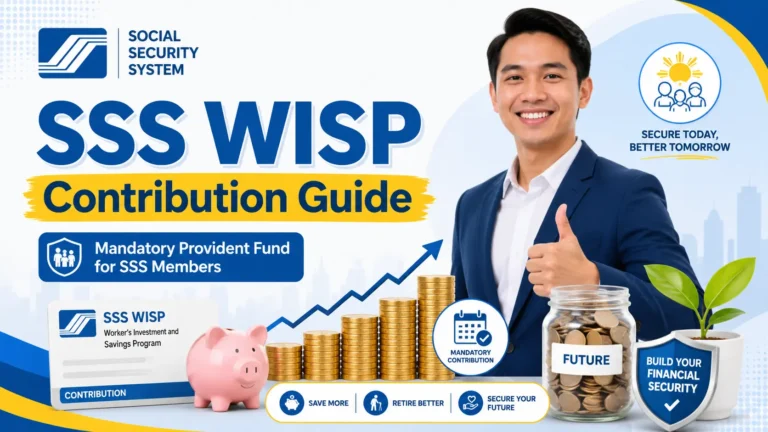
Read our complete guide to the Mandatory MySSS Pension Booster, formerly WISP if your MSC is above ₱20,000.
Does Paying More Than 120 Contributions Help?
The 120-contribution requirement determines basic eligibility for the monthly retirement pension, but reaching 120 does not mean additional contributions become meaningless.
Your regular pension computation considers factors that can include:
AMSC
and
CYS — Credited Years of Service
A longer qualifying contribution history can therefore affect the pension formula.
For example, two members could both qualify for retirement:
Member A: 120 contributions
Member B: 300 contributions
They should not automatically expect identical benefits simply because both passed the 120-contribution threshold.
Their credited years and salary-credit histories may be different.
How to Pay SSS Contributions as a Voluntary Member
Eligible Voluntary Members can generate a Payment Reference Number (PRN) using official SSS facilities such as:
- My.SSS;
- SSS Mobile App; and
- other supported SSS channels.
When generating the PRN, choose:
Voluntary Member
as the membership type and select the appropriate contribution information.
Payment may then be made through SSS-authorized payment channels.
Because payment facilities and partners can change, check the current options displayed by SSS when you generate the PRN.
How to Check Whether Your Contributions Are Posted
Paying is only part of the process.
You should periodically check whether your contributions are actually reflected in your SSS record.
Log in to your My.SSS account or use the official SSS Mobile App and review your contribution history.
Pay particular attention to:
- missing contribution months;
- incorrect MSC;
- contributions posted under the wrong period;
- gaps in voluntary payments; and
- your total contribution count.
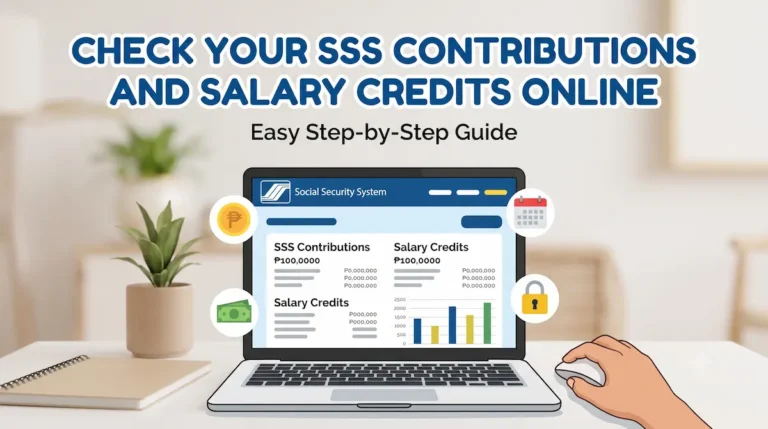
Our guide on checking SSS contributions and salary credits online explains how to review your record.
This becomes increasingly important as you approach the 120-contribution requirement or retirement age.
How Much Pension Can a Voluntary Member Receive?
There is no special fixed pension amount exclusively for Voluntary Members.
If you qualify for the regular monthly retirement pension, SSS uses the applicable retirement-benefit formulas.
Current SSS guidance determines the regular monthly pension from the highest applicable result of its statutory formulas, which take factors such as AMSC and CYS into account.
This means Voluntary Member status by itself does not determine whether your pension will be ₱3,000, ₱8,000, ₱12,000 or another amount.
The result depends on your actual SSS record.
Use our SSS Pension Calculator for an estimate, but remember that only SSS can determine your official retirement benefit.
Can a Voluntary Member Receive a Lump-Sum Retirement Benefit?
Yes.
A member who reaches the applicable retirement age but has fewer than 120 monthly contributions prior to the semester of retirement may qualify for a lump-sum retirement benefit.
SSS describes this as a one-time cash benefit based on applicable contributions and interest.
However, members who are short of 120 contributions should remember that they may have another option:
continue paying voluntarily until completing 120 contributions.
That decision can have a significant effect on your retirement income, so check your exact contribution record before filing.
How to Apply for SSS Retirement as a Voluntary Member
Qualified Voluntary Members generally file their retirement benefit claim online through the My.SSS Portal.
This is important because older guides may tell all retirees to simply visit a branch.
For ordinary qualified claims, online filing is now the standard route.
Before Filing Online
You generally need:
- an active My.SSS account; and
- an approved/enrolled disbursement account through the Disbursement Account Enrollment Module (DAEM), unless your applicable enrolled UMID-ATM arrangement is being used under SSS rules.
Basic Online Process
The process generally involves:
- Log in to your My.SSS account.
- Open the Retirement Benefit application.
- Review your personal information.
- Answer the required eligibility questions.
- Review the retirement-benefit information shown by SSS.
- Choose whether to avail of the advance 18-month pension option if it is offered and applicable.
- Read the certification carefully.
- Submit the retirement claim.
- Keep the confirmation/reference information generated by SSS.
Always follow the current instructions shown in My.SSS because online screens and procedures may change.
When Must a Retirement Claim Be Filed at an SSS Branch?
Not every claim can be processed completely online.
SSS currently identifies certain cases that require filing through an SSS Branch Office or applicable Foreign Representative Office.
Examples include claims involving:
- certain outstanding special loan balances;
- dependent children under guardianship;
- an incapacitated member or member under guardianship;
- confinement in certain institutions;
- application of the Portability Law;
- bilateral Social Security Agreements;
- adjustment or re-adjudication of an existing claim; or
- certain unclaimed benefits of a deceased member.
Document requirements vary according to the particular case.
This is why I do not recommend relying on a huge generic “valid IDs” list from an old article. Follow the specific documentary requirements SSS gives for your type of claim.
Can a Voluntary Retiree Take the First 18 Months in Advance?
SSS currently provides qualified retiring members with an option to receive the first 18 monthly pensions in advance as a lump sum, discounted at a preferential interest rate determined by SSS.
This option is generally exercised when filing the initial retirement claim.
It should not be confused with the lump-sum retirement benefit for someone who has fewer than 120 contributions.
They are two completely different things:
Advance 18-month pension → for an eligible monthly pensioner choosing an advance-payment option.
Retirement lump-sum benefit → generally for a retiree who has not completed the 120-contribution requirement and does not continue contributing to qualify for the monthly pension.
Read the conditions carefully before choosing an advance pension.
Common Mistakes Voluntary Members Should Avoid
Paying as a Voluntary Member Without Previous Coverage
An SS Number alone is not enough.
You generally need a previous valid posted contribution as an employee, self-employed member or OFW before becoming a Voluntary Member.
Assuming Missed Months Can Be Paid Years Later
Voluntary contribution gaps generally cannot be retroactively filled after the applicable payment period.
Waiting Until Age 59 to Think About Contributions
Review your contribution count and MSC much earlier.
The age-55 MSC restrictions can make last-minute increases difficult.
Assuming Exactly 120 Contributions Gives the Highest Pension
120 contributions establish an important eligibility threshold.
The actual pension calculation also depends on AMSC, CYS and applicable SSS formulas.
Not Checking Whether Payments Were Posted
Keep payment records, but also verify the contributions in My.SSS.
Choosing a Contribution Amount Without Understanding Pension Booster
If your MSC exceeds ₱20,000, part of the applicable contribution is allocated to the Mandatory MySSS Pension Booster rather than being treated entirely as the regular Social Security component.
Retirement Checklist for a Voluntary Member
Before filing your retirement claim:
Check your age.
Determine whether you are applying under optional or technical retirement rules.
Count your posted contributions.
Do not estimate them only from the number of years you remember paying.
Confirm the 120-contribution requirement.
Remember that SSS specifies contributions prior to the semester of retirement.
Check for contribution gaps.
Voluntary Member gaps generally cannot simply be back-paid later.
Review your MSC history.
This is particularly important if you changed contribution levels after age 55.
Check My.SSS.
Make sure your personal and contribution records are correct.
Enroll your disbursement account.
Complete the required DAEM process if applicable before filing.
Estimate your benefit.
Use the SSS Pension Calculator for planning.
Follow the current SSS filing instructions.
Most ordinary qualified VM claims are filed online, while special cases require branch processing.
Frequently Asked Questions
Can a Voluntary Member receive an SSS pension?
Yes. A Voluntary Member who meets the applicable age, contribution and retirement requirements can qualify for an SSS monthly retirement pension.
How many contributions does a Voluntary Member need for a monthly pension?
Generally, at least 120 monthly contributions prior to the semester of retirement are required.
Can I become a Voluntary Member if I only have an SS Number?
Not normally if you have never had qualifying SSS coverage. A Voluntary Member generally needs at least one valid posted contribution from previous employee, self-employed or OFW coverage.
Do 120 contributions need to be consecutive?
No. Your qualifying contribution history may contain gaps and may come from different periods of SSS coverage.
Can I pay missed Voluntary Member contributions?
Generally, missed contribution periods that have become gaps cannot be filled through retroactive payment.
What is the minimum Voluntary Member contribution in 2026?
Under the current contribution schedule, the minimum MSC is ₱5,000. At the current 15% contribution rate, that corresponds to ₱750 per month.
What is the maximum Voluntary Member contribution?
The current maximum MSC is ₱35,000, corresponding to a total contribution of ₱5,250 per month under the current 15% structure.
Can I choose any MSC when becoming a Voluntary Member for the first time?
Current SSS rules generally allow a first-time VM to choose an MSC from the existing contribution schedule regardless of age and the previous posted MSC, subject to SSS rules.
Can I increase my contribution after age 55?
There are restrictions. A Voluntary Member age 55 or above may generally increase the MSC only once per calendar year and by one salary bracket from the last posted MSC, subject to specific exceptions.
Can I continue paying SSS after age 60?
Yes, in applicable circumstances. SSS allows a member age 60 but below 65 with 120 or more contributions to continue voluntary contributions until 65.
Can I continue paying after age 65 if I have fewer than 120 contributions?
Yes. SSS allows a member age 65 or older with fewer than 120 contributions to continue paying voluntarily until completing 120 contributions for monthly-pension eligibility.
What happens if I retire with fewer than 120 contributions?
You may be eligible for a one-time lump-sum retirement benefit, or you may choose to continue paying voluntarily until completing 120 contributions if you meet the applicable SSS conditions.
Do higher voluntary contributions guarantee a higher pension?
No fixed increase is guaranteed. Your retirement pension depends on factors including AMSC, CYS and your overall contribution history.
Does MSC above ₱20,000 count toward my regular pension?
Under the current structure, contributions associated with MSC above ₱20,000 up to ₱35,000 are allocated to the Mandatory MySSS Pension Booster. Read our Mandatory MySSS Pension Booster guide for details.
How can I estimate my pension as a Voluntary Member?
First check your actual contribution history in My.SSS. Then use our SSS Pension Calculator for a planning estimate.
Bottom Line
Voluntary Members can qualify for a regular SSS monthly retirement pension.
The key rule to remember is:
At least 120 monthly contributions prior to the semester of retirement.
But retirement planning should not stop at counting to 120.
Voluntary Members should also understand:
- contribution gaps generally cannot be back-paid;
- members short of 120 may continue paying voluntarily;
- members 65 or older may still complete the 120-contribution requirement;
- MSC increases become more restricted from age 55;
- contributions associated with MSC above ₱20,000 enter the Mandatory MySSS Pension Booster;
- AMSC and CYS affect the actual pension calculation; and
- most ordinary Voluntary Member retirement claims are now filed through My.SSS.
Check your official contribution record well before retirement rather than waiting until the month you intend to file.
Once you know your contribution history, use our SSS Pension Calculator to estimate your potential retirement income.
Information Accuracy and Official Sources
Last manually reviewed against official SSS sources: September 10, 2026.
This guide was reviewed against current information published by the Philippine Social Security System, including:
- SSS Voluntary Member guidelines
- SSS Retirement Benefit guidelines
- Current SSS Contribution Table for Voluntary Members
- SSS Pay Contributions guidance
- Mandatory MySSS Pension Booster rules
- Current My.SSS retirement-claim procedures
SSS contribution schedules, benefit rules and online procedures may change. For account-specific concerns or where official SSS information differs from this guide, follow the latest instructions issued directly by the Social Security System.
SSSPensionCalculator.ph is an independent informational website and is not affiliated with or operated by the Philippine Social Security System.

4 Comments