
How Many Contributions Are Needed to Get SSS Pension Benefit
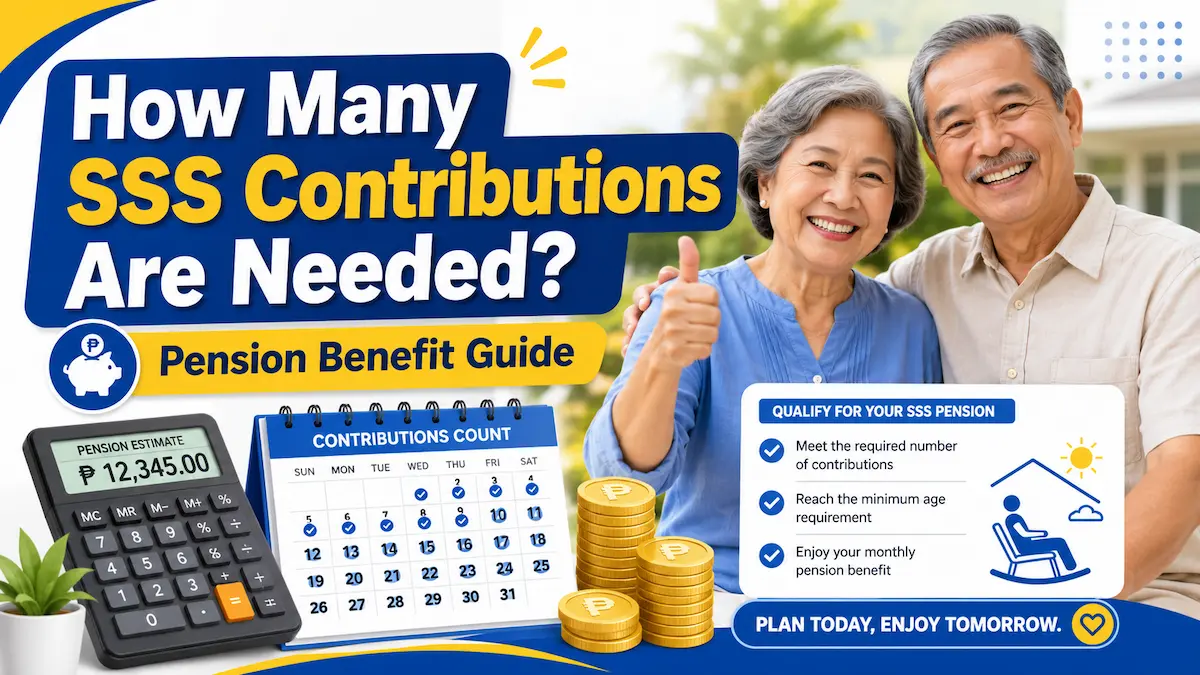
SSTo qualify for a monthly SSS retirement pension, a member generally needs at least 120 monthly contributions paid before the semester of retirement.
That is the basic rule.
However, “120 contributions” is often misunderstood. It does not necessarily mean 10 uninterrupted years with the same employer, and reaching age 60 with only 110 or 119 contributions does not automatically mean you have lost the chance to receive a monthly pension.
SSS allows eligible members who are short of the required 120 contributions to continue paying as Voluntary Members until they complete the requirement.
This guide explains how the 120-contribution rule works, what “before the semester of retirement” means, what happens if you have fewer than 120 contributions, and whether paying more than 120 contributions can affect your retirement benefit.
If you already know your contribution history, you can use our SSS Pension Calculator to estimate your potential monthly retirement benefit.
How Many SSS Contributions Are Required for a Monthly Pension?
You generally need:
At least 120 monthly SSS contributions before the semester of retirement
to qualify for a monthly SSS retirement pension.
In simple terms:
- 120 contributions or more → potentially eligible for a monthly pension, provided the other retirement requirements are also met.
- Fewer than 120 contributions → not yet qualified for the monthly pension based on contribution count alone.
- Fewer than 120 contributions → you may have the option to continue paying voluntarily until you reach 120.
- If you do not complete 120 → you may qualify for the applicable lump-sum retirement benefit instead.
The contribution requirement is only one part of retirement eligibility. Your age and employment status also matter.
Does 120 SSS Contributions Mean 10 Years?
Mathematically:
120 monthly contributions ÷ 12 = 10 years
So 120 contribution months are equivalent to 10 years of monthly contributions.
But this does not necessarily mean you must work continuously for exactly 10 years.
For example, suppose you contributed:
- 36 months while working for Employer A
- stopped paying for two years
- paid another 60 months while working for Employer B
- later paid 24 months voluntarily
Your total would still be:
36 + 60 + 24 = 120 monthly contributions
The months do not necessarily have to be continuous.
What matters for the basic monthly-pension requirement is whether you have accumulated at least 120 valid monthly contributions prior to the semester of retirement.
What Does “Prior to the Semester of Retirement” Mean?
This is one of the most important parts of the SSS rule.
SSS does not simply say:
120 contributions before your retirement date.
It specifically requires:
120 monthly contributions prior to the semester of retirement.
Under SSS rules, a semester consists of two consecutive calendar quarters ending in the quarter when the contingency occurs.
A quarter is one of these three-month periods:
- January to March
- April to June
- July to September
- October to December
Example
Suppose your retirement contingency occurs in May.
May falls in the:
April–June quarter
The semester of retirement therefore consists of:
January–March + April–June
or:
January through June
For purposes where SSS requires contributions prior to the semester of retirement, the relevant contributions generally need to fall before that semester.
This is why simply looking at the contribution count displayed on the day you turn 60 may not be enough to determine eligibility.
Your actual contribution dates and retirement semester matter.
If you are close to retirement and close to the 120-contribution requirement, verify your record through My.SSS or directly with SSS before filing your claim.
SSS Retirement Age: 60 vs 65
Having 120 contributions alone does not automatically mean you can claim the pension immediately.
For most SSS members, there are two important retirement ages.
Optional Retirement at Age 60
A member may generally qualify for optional retirement beginning at age 60 if the required contribution condition is met and the member has stopped the applicable work or coverage activity.
For example, an employed member generally needs to be separated from employment.
The rule also covers the applicable cessation of self-employment, OFW work, or household-helper employment.
Special retirement ages apply to certain occupations such as qualified mineworkers and racehorse jockeys.
Technical Retirement at Age 65
At age 65, a member may generally qualify for technical retirement whether still employed, self-employed, working as an OFW or household helper, or no longer working, subject to the applicable SSS rules.
So for most members:
Age 60 → optional retirement, subject to work-status requirements
Age 65 → technical retirement
The contribution requirement for a monthly pension remains important in either case.
What If I Have Fewer Than 120 SSS Contributions?
Having fewer than 120 contributions does not necessarily mean you should immediately take a lump sum.
SSS provides an important option.
A member filing for retirement with fewer than 120 monthly contributions may choose to continue paying contributions as a Voluntary Member until completing the required 120 months.
Once the qualifying requirement is completed according to SSS rules, the member may then qualify for the monthly retirement pension.
Example: 110 Contributions
Suppose you reach retirement age with only:
110 qualifying monthly contributions
You are:
10 contributions short
Instead of immediately taking the applicable lump-sum benefit, you may choose to continue contributing voluntarily until you complete the required contribution count.
After completing the requirement and satisfying the applicable retirement rules, you can file for the monthly pension.
Example: 119 Contributions
Suppose you have:
119 contributions
You are only one contribution short of the basic 120-month requirement.
Do not assume that you should immediately file for a lump sum.
Check your My.SSS contribution record and the applicable semester rule, and verify with SSS when you can complete the qualifying contribution requirement.
Example: 75 Contributions
Suppose you have only:
75 monthly contributions
You would need another:
45 contribution months
to reach 120.
Depending on your age and circumstances, you may choose to continue paying as a Voluntary Member rather than immediately taking a lump-sum retirement benefit.
Before deciding, compare the time required to complete the contributions with your individual retirement situation.
Can a Member Over Age 65 Continue Paying Until Reaching 120 Contributions?
Yes, SSS specifically provides an option for qualifying members who reach age 65 with fewer than 120 contributions.
A member aged 65 or older with fewer than 120 contributions may continue paying as a Voluntary Member until the required 120 contributions are completed for monthly-pension eligibility.
This is an important rule because many members incorrectly assume that contribution payments must permanently stop once they turn 65.
If you are already paying voluntarily or considering doing so, read our detailed guide to SSS pension requirements for voluntary members.
What Happens If I Do Not Complete 120 Contributions?
If you have fewer than 120 qualifying monthly contributions and choose not to continue paying until you reach the requirement, you may qualify for an SSS lump-sum retirement benefit.
SSS describes the retirement lump sum as a one-time cash benefit for a retiree member who has not met the required 120 monthly contributions.
The benefit is based on the applicable total contributions paid, including interest earned under SSS rules.
This is different from receiving a regular monthly pension for life.
Therefore, before deciding between:
continuing contributions
and
taking the applicable lump-sum retirement benefit
it is worth checking:
- how many contributions you are short;
- how long completing 120 contributions would take;
- your current age;
- your financial circumstances;
- your SSS contribution record; and
- the latest SSS retirement rules.
For account-specific decisions, confirm your options directly with SSS.
Is the SSS Pension Paid for Life?
For a member who qualifies for the regular monthly retirement pension, SSS describes the monthly pension as a lifetime cash benefit.
That means it is not normally limited to a fixed period such as five, ten or twenty years.
The pension is paid according to the applicable SSS retirement rules while the retiree remains entitled to it.
Do More Than 120 Contributions Increase My SSS Pension?
Completing 120 contributions makes you eligible for the monthly pension, but 120 is not necessarily the point at which additional contributions stop mattering.
The amount of a regular SSS pension depends on factors including:
- Average Monthly Salary Credit (AMSC)
- Credited Years of Service (CYS)
- applicable SSS pension formulas
SSS uses multiple formulas and generally pays the highest applicable result.
One formula takes the member’s Credited Years of Service into account. This means that a longer qualifying contribution history can affect the pension computation.
So:
120 contributions determine basic monthly-pension eligibility, but they do not automatically determine the final pension amount.
Two members who both have 120 or more contributions can receive different pensions because their salary credits and credited years of service may be different.
You can use our SSS Pension Calculator to understand how different retirement factors may affect your estimate.
Your contribution history also affects your Average Monthly Salary Credit. You can estimate it with our SSS AMSC Calculator.
Contribution months and Credited Years of Service are related but not always calculated the same way. Use our SSS CYS Calculator to estimate your CYS.
120 Contributions vs Credited Years of Service
These two terms should not be treated as identical.
Monthly Contributions
This refers to the number of monthly SSS contributions posted to the member’s record.
The important eligibility threshold for a regular retirement pension is:
120 monthly contributions
Credited Years of Service
CYS is used in the SSS pension computation.
Under SSS rules, credited years depend on the applicable contribution history and calendar years that meet SSS requirements.
Therefore:
120 monthly contributions ≠ automatically the exact CYS used in every pension calculation
This is another reason an accurate SSS pension estimate requires more information than simply asking:
“Have you contributed for 10 years?”
Does a Higher Contribution Mean a Higher Pension?
Potentially, yes, because Monthly Salary Credits are used in calculating the Average Monthly Salary Credit used for retirement benefits.
However, the relationship is not simply:
Pay twice as much → receive twice the pension.
SSS calculates the regular monthly pension using statutory formulas.
The amount depends on the member’s actual contribution and salary-credit history, credited years of service, and other applicable SSS rules.
Members with salary credits above the regular Social Security threshold may also have contributions allocated to the Mandatory MySSS Pension Booster, formerly called WISP.
That account is separate from the regular pension computation.
If your records include WISP or Mandatory Pension Booster contributions, see our guide to the Mandatory MySSS Pension Booster and former WISP.
Does My SSS Membership Type Change the 120-Contribution Requirement?
The basic monthly-retirement-pension requirement applies across covered membership types.
A qualifying contribution history may include contributions from different stages of your SSS membership.
For example, a person may have contributed as:
- an employee;
- self-employed member;
- OFW; and later
- Voluntary Member.
Changing membership category does not mean your previously valid contributions automatically disappear.
Your posted contribution history remains important.
This is why a former employee who stops working may choose to continue contributing voluntarily to maintain eligibility for future SSS benefits.
How Do I Know How Many SSS Contributions I Have?
Do not estimate your total only from the number of years you remember working.
Check your actual posted contribution record.
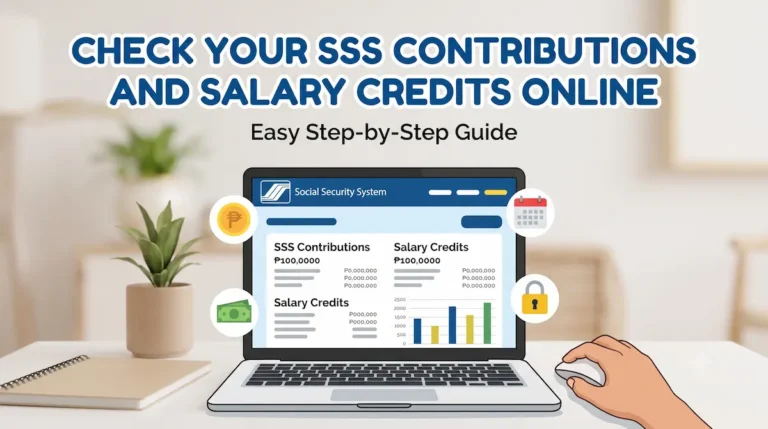
You can do this through your official My.SSS account or SSS Mobile App.
Review your contribution history and look for:
- missing months;
- incorrect contribution amounts;
- gaps between employers;
- periods when you were self-employed or voluntary;
- unpaid months; and
- the total number of valid posted contributions.
If something is missing, address it before you are ready to file a retirement claim.
For example, if you believe you already have 120 contributions but several employer remittances were never posted correctly, your SSS record may not match your personal calculation.
Your official SSS record, not a handwritten estimate, is what matters when your retirement benefit is processed.
How to Apply for the SSS Retirement Benefit
Many eligible members can file their retirement benefit claim through the My.SSS Member Portal.
However, SSS requires certain special cases to be handled through an SSS branch or appropriate foreign representative office.
Examples may include claims involving particular guardianship situations, Portability Law or bilateral social-security arrangements, certain outstanding loan programs, adjustments or re-adjudication, and other special circumstances identified by SSS.
Because filing procedures can change, check the latest instructions in My.SSS before preparing your claim.
Before Filing for Retirement: Simple Checklist
Before you submit an SSS retirement claim, check these items:
1. Verify your age eligibility
Determine whether you are applying for optional or technical retirement.
2. Check your posted contribution history
Confirm that your records contain the contributions you expect.
3. Confirm the 120-contribution requirement
For a monthly pension, verify that you meet the required contribution count prior to the semester of retirement.
4. Check your employment or membership status
This is particularly important for optional retirement before age 65.
5. Decide what to do if you have fewer than 120 contributions
You may have the option to continue paying voluntarily.
6. Review your My.SSS information
Make sure your contact and account details are current.
7. Estimate your retirement benefit
Use our SSS Pension Calculator as a planning estimate, then rely on SSS for your official benefit computation.
Common Mistakes About the 120-Contribution Rule
“I worked for 10 years, so I definitely have 120 contributions.”
Not necessarily.
There may be contribution gaps, missing employer remittances or months when no contribution was posted.
Check My.SSS.
“I have 120 contributions today, so I automatically qualify.”
Not necessarily.
SSS specifies 120 monthly contributions prior to the semester of retirement. Timing matters.
“If I only have 119 contributions, I can never receive a pension.”
Incorrect.
Eligible members who are short of 120 may continue contributing voluntarily until they complete the requirement.
“After age 65 I cannot contribute anymore.”
Not necessarily.
SSS allows a member aged 65 or above with fewer than 120 contributions to continue as a Voluntary Member until the required 120 contributions are completed.
“Once I reach 120 contributions, additional contributions have no value.”
Incorrect.
The pension amount depends on more than eligibility alone. AMSC, CYS and the applicable pension formulas affect the actual benefit.
Bottom Line
For most SSS members, the key requirement is:
At least 120 monthly contributions prior to the semester of retirement
for a regular monthly pension.
But remember these four points:
- 120 contributions do not have to mean 10 uninterrupted years of employment.
- The timing of the contributions relative to your retirement semester matters.
- If you are short of 120, you may be allowed to continue paying voluntarily until you complete the requirement.
- Having more than 120 contributions may still matter because pension computation also depends on salary credits and credited years of service.
Before filing a retirement claim, check your actual contribution record through My.SSS.
If you already meet the requirement and want to estimate your potential benefit, use our SSS Pension Calculator.
Information Accuracy and Official Sources
Last manually reviewed against official SSS sources: September 10, 2026.
This guide was reviewed using current information published by the Philippine Social Security System, including its Retirement Benefit guidance, Voluntary Member rules and retirement-claim procedures.
SSS rules and procedures may change. Your official SSS contribution record and the latest instructions issued by SSS should always take priority over estimates or general information on independent websites.
SSSPensionCalculator.ph is an independent informational website and is not affiliated with or operated by the Philippine Social Security System.


5 Comments