SSS Disability Benefit 2026: Requirements, Monthly Pension, Lump Sum & How to Apply
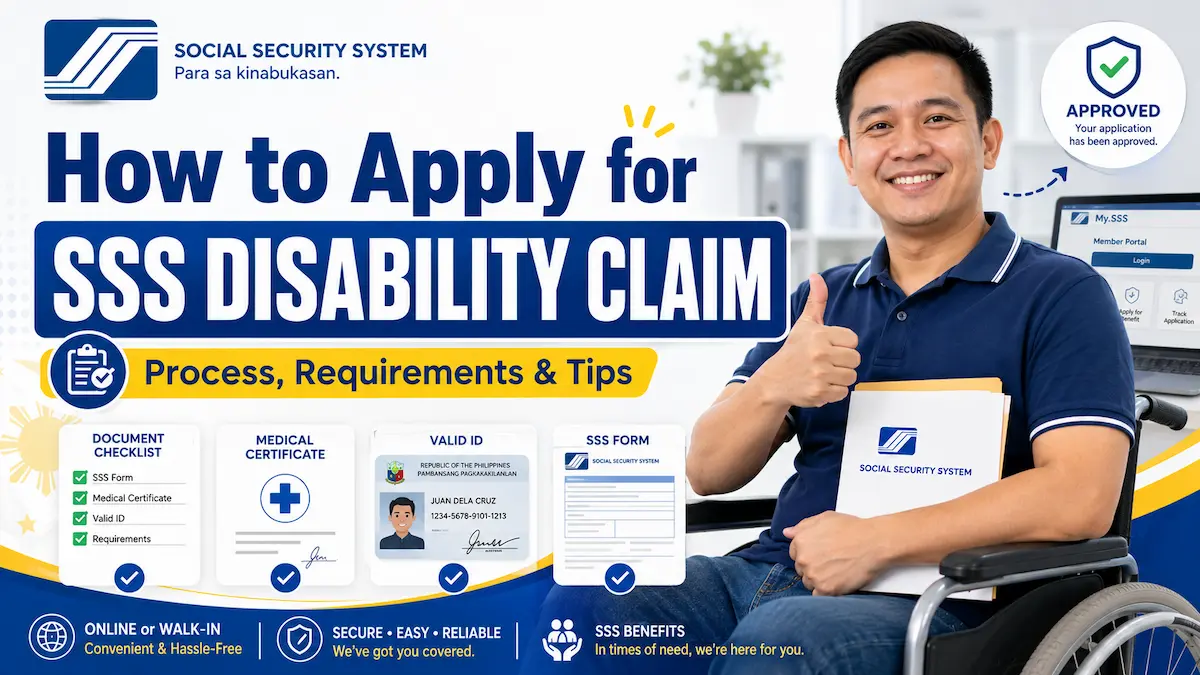
The SSS Disability Benefit is a cash benefit for an SSS member who becomes permanently disabled, either partially or totally.
You do not need 120 contributions to qualify for an SSS disability benefit. That 120-month requirement applies to the regular retirement pension.
For disability benefits, the important contribution rules are different:
- At least 1 monthly contribution paid before the semester of disability may qualify a member for a disability benefit.
- At least 36 monthly contributions before the semester of disability are generally required to receive a monthly disability pension.
- If you have fewer than 36 contributions, the benefit is generally paid as a lump sum instead.
The Social Security System evaluates the medical condition, degree of disability, contribution record, and other eligibility requirements before approving a claim.
This guide explains the current SSS disability requirements, permanent partial and permanent total disability, monthly pension versus lump sum, documents, filing process, payment, dependent benefits, and the 2026 pension increase.
What Is the SSS Disability Benefit?
SSS defines disability as a restriction or loss of the ability to perform an activity normally because of an impairment.
The SSS Disability Benefit is available when a member becomes permanently disabled, either:
Permanent Partial Disability (PPD)
or
Permanent Total Disability (PTD)
Depending on the member’s contribution history and the disability assessment, SSS may pay the benefit as:
a monthly pension
or
a lump-sum amount.
Disability does not have to result only from an accident. A qualifying disability can also result from illness or another medical condition, subject to evaluation and approval by SSS.
How Many SSS Contributions Are Required for Disability Benefit?
The contribution requirement depends on the type of payment you qualify for.
At Least 1 Contribution
A member who becomes permanently partially or totally disabled may qualify for an SSS disability benefit if they have paid at least:
1 monthly SSS contribution before the semester of disability.
That establishes the basic contribution requirement for the disability benefit.
At Least 36 Contributions for a Monthly Pension
To qualify for a monthly disability pension, the member generally needs:
at least 36 monthly contributions paid before the semester of disability.
This is much lower than the contribution requirement for a retirement pension.
| Benefit | Basic Contribution Requirement |
|---|---|
| Disability benefit eligibility | At least 1 contribution |
| Monthly disability pension | At least 36 contributions |
| Regular retirement monthly pension | At least 120 contributions |
If you are checking retirement eligibility rather than disability, read our guide explaining how many SSS contributions are needed for a retirement pension.
Monthly Disability Pension vs Lump Sum
SSS can pay disability benefits in two main forms.
Monthly Disability Pension
A monthly pension is generally payable to a qualified disabled member who paid at least:
36 monthly contributions before the semester of disability.
The pension amount depends on factors such as:
- number of paid contributions;
- Monthly Salary Credits;
- Credited Years of Service; and
- the member’s SSS record before the semester of disability.
Lump-Sum Disability Benefit
A lump sum generally applies when the member:
- has fewer than 36 qualifying contributions; or
- is assessed for a permanent partial disability benefit payable for less than 12 months.
A lump sum is a one-time payment, rather than an ongoing monthly disability pension.
Minimum SSS Disability Pension
According to current SSS guidance, the minimum monthly disability pension depends on the member’s Credited Years of Service (CYS).
| Credited Years of Service | Minimum Monthly Disability Pension |
|---|---|
| Less than 10 CYS | ₱1,000 |
| At least 10 CYS | ₱1,200 |
| At least 20 CYS | ₱2,400 |
These amounts refer to the applicable minimum disability pension under the regular SSS program.
Other disability-related allowances may be paid separately.
Permanent Partial Disability vs Permanent Total Disability
These two categories are not interchangeable.
Permanent Partial Disability
Permanent Partial Disability means a permanent loss or loss of use of a particular part of the body without necessarily making the member completely unable to perform all gainful work.
Examples recognized by SSS include permanent loss or loss of use of:
- a thumb or finger;
- a hand or arm;
- a foot or leg;
- an ear or hearing;
- sight of one eye; and
- certain other conditions recognized under SSS rules.
Certain permanent losses involving female reproductive organs may also qualify under specific SSS conditions.
The actual percentage and compensable period depend on the disability determined by SSS.
Permanent Total Disability
Permanent Total Disability involves much more severe permanent incapacity.
Examples specifically identified by SSS include:
- complete loss of sight of both eyes;
- loss of two limbs at or above the ankles or wrists;
- permanent complete paralysis of two limbs;
- certain severe brain injuries; and
- other cases determined and approved by SSS.
The final classification is made by SSS based on medical evaluation.
How Is a Permanent Partial Disability Benefit Paid?
A permanent partial disability benefit may be paid monthly for a specific compensable period determined by the disability assessment.
Different permanent losses have different prescribed periods.
For example, SSS rules assign different compensability periods for the complete and permanent loss or loss of use of a:
- finger;
- hand;
- arm;
- foot;
- leg;
- ear;
- hearing; or
- sight of one eye.
If the resulting permanent partial disability pension would be payable for less than 12 months, SSS generally pays it as a lump sum instead.
This is why two members with permanent partial disabilities should not assume that their benefit duration or amount will be identical.
How Is the Disability Lump Sum Calculated?
The calculation differs for permanent total and permanent partial disability.
Permanent Total Disability With Fewer Than 36 Contributions
For permanent total disability, SSS generally compares:
Monthly pension × number of monthly contributions paid before the semester of disability
against:
Monthly pension × 12
and pays the higher applicable amount.
Permanent Partial Disability
For permanent partial disability, the calculation also considers the percentage or degree of disability.
Because SSS determines the medical degree of disability, you should not try to estimate your final lump-sum benefit from contribution count alone.
Additional ₱1,000 Benefit for Disability Pensioners
Qualified monthly disability pensioners currently receive an additional:
₱1,000 per month
on top of the applicable monthly disability pension.
This additional benefit has been paid since January 2017.
It is separate from the basic pension calculation.
₱500 Supplemental Disability Allowance
SSS also provides a:
₱500 supplemental disability allowance
to qualified partial and total disability pensioners.
The supplemental allowance is intended to help with additional needs related to the member’s disability.
Therefore, depending on eligibility, a disability pensioner’s monthly SSS payment may involve more than just the basic pension amount.
Is There a 13th-Month Disability Pension?
Yes, depending on the type of disability pension.
Permanent Total Disability
A permanent total disability pensioner is entitled to a 13th-month pension, generally payable in December.
Permanent Partial Disability
A permanent partial disability pensioner may receive a 13th-month pension when the approved pension duration is at least:
12 months.
This distinction is important because not every permanent partial disability pension lasts 12 months or longer.
Dependent’s Pension for a Total Disability Pensioner
Qualified dependent children of a permanent total disability pensioner may receive a dependent’s pension.
For each qualified dependent child, the pension is generally:
10% of the member’s monthly pension
or
₱250
whichever is higher.
SSS allows benefits for up to five qualified dependent children, beginning with the youngest, subject to its dependency rules.
The dependent’s pension does not generally apply to children of a member receiving a permanent partial disability pension.
How Long Does a Dependent’s Pension Continue?
A dependent child’s pension generally stops when the child:
- reaches age 21;
- gets married;
- becomes gainfully employed; or
- dies.
However, special rules may allow the benefit to continue beyond age 21 when the child is incapacitated and incapable of self-support because of a qualifying physical or mental disability that was congenital or acquired while still a minor.
Eligibility is determined by SSS.
Does the 2026 SSS Pension Increase Apply to Disability Pensioners?
Yes, qualifying disability pensioners are included in the SSS Pension Reform Program (PRP).
Under the second tranche implemented in 2026:
Retirement and disability pensioners receive a 10% increase in their monthly pensions, subject to the official SSS eligibility and effectivity rules.
SSS announced the following 2026 timing:
- Pensioners covered as of May 31, 2026 receive the applicable second-tranche increase beginning June 1, 2026.
- Pensioners whose disability contingency falls from June 1 through August 31, 2026 receive the applicable increase beginning September 1, 2026.
Members with a later contingency date should check the latest SSS Pension Reform rules rather than automatically assuming that the same adjustment applies.
The Pension Reform increase should also not be confused with the separate ₱1,000 additional benefit or ₱500 supplemental disability allowance.
What Documents Are Needed for an SSS Disability Claim?
SSS currently lists the following among the basic documents for a disability claim:
Disability Claim Application
Complete the official Disability Claim Application (DisCA) Form.
The current form can be obtained from SSS.
Member’s/Claimant’s Photo and Signature Form
This may be provided by the SSS branch for an initial disability claim.
SSS Medical Certificate
The SSS Medical Certificate should be completed by your attending physician.
Current SSS guidance states that it should generally be accomplished within six months from the date of filing.
Supporting Medical Records
Submit the medical documents appropriate to your disability.
Depending on the condition, SSS may request documents such as:
- hospital abstract or discharge summary;
- consultation records;
- operation records;
- X-ray results;
- CT scan or MRI results;
- laboratory results;
- ECG or 2D Echo results;
- psychiatric evaluation;
- audiogram;
- pathology/histopathology reports; or
- dialysis treatment records.
The required evidence depends on your medical condition.
Valid Identification
The claimant should also bring acceptable SSS or government-issued identification.
SSS may require additional documents depending on the claim.
When Can You File for Different Disabilities?
Some medical conditions require a specific waiting or observation period before the disability can be properly evaluated.
Current SSS guidance gives examples such as:
- certain fractures — around four months after injury or operation;
- stroke — around four months after onset;
- certain pulmonary tuberculosis classifications — after the applicable observation period;
- certain mental illnesses — after a longer medical-history period;
- diabetes-related disability — based on sufficient medical history;
- cataract operation — around four months after surgery.
Do not treat these examples as a complete medical timetable.
The correct filing time depends on your actual condition and the current SSS medical-evaluation requirements.
Where Do You File an SSS Disability Claim?
Current official SSS guidance states that a disability-benefit application is filed at an:
SSS branch
within the applicable filing period.
Unlike ordinary retirement claims, which many members can submit online through My.SSS, a disability claim involves a medical assessment and supporting medical documentation.
The SSS Medical Specialist may:
- review the submitted records;
- request additional medical evidence;
- require a physical examination; or
- conduct further verification when necessary.
Do not assume approval merely because your attending doctor described you as disabled. SSS makes the benefit determination under its own rules.
Can Someone File the Disability Claim for You?
In certain situations, SSS allows a representative to file the claim for the member.
Current guidance includes situations where the member is:
- wheelchair-bound;
- in respiratory distress;
- receiving IV fluids or experiencing another debilitating condition;
- confined in a hospital or other institution; or
- residing abroad.
A representative should follow the current SSS requirements regarding identification, authorization, and supporting documents.
Is There a Deadline for Filing an SSS Disability Claim?
Yes.
Current SSS guidance states that an application for disability benefits should generally be filed within:
10 years from the occurrence of disability.
Do not interpret this long filing period as a reason to delay unnecessarily.
Medical evidence can become more difficult to obtain as time passes, and certain conditions also have their own medical evaluation requirements.
When you believe you may qualify, verify the appropriate filing time with SSS.
How Is the Approved Disability Benefit Paid?
SSS uses electronic benefit-disbursement methods.
Depending on the qualified payee’s setup, payment may be made through an eligible:
- UMID card enrolled as an ATM account;
- PESONet participating bank account;
- electronic wallet;
- accredited remittance transfer company; or
- cash payout outlet.
Where required, the member should enroll the applicable disbursement information through the Disbursement Account Enrollment Module (DAEM) in My.SSS.
SSS may require proof of the account and identity-verification documents.
How Long Does Payment Take After the Claim Is Settled?
Current SSS disability guidance states that benefit payments are generally credited within:
5 to 7 banking days from the date of settlement of the claim.
This is not the same as saying the entire disability application will be approved in 5 to 7 days.
The claim itself may require document review, medical evaluation, additional records, or further examination before settlement.
That is why we do not recommend relying on websites that promise a fixed “two-week approval” for every disability claim.
What Happens If the Benefit Cannot Be Credited?
If payment to the enrolled account is unsuccessful, SSS may require the member to:
- update the existing disbursement-account information; or
- enroll a new disbursement account through DAEM.
The member may then need to request re-disbursement using the applicable My.SSS facility.
Representative-payee cases can have separate branch requirements.
Can SSS Stop a Permanent Total Disability Pension?
Yes, certain events can affect an ongoing disability pension.
Current SSS rules state that permanent total disability pension and applicable dependent benefits may be affected if the member:
- recovers from the permanent total disability;
- resumes employment;
- resumes self-employment; or
- fails to comply with required SSS examination or pensioner-confirmation procedures.
A member receiving a permanent total disability pension may need to comply with the Annual Confirmation of Pensioners (ACOP) or other SSS verification requirements.
Failure to comply can result in suspension.
What Happens If a Disability Pensioner Returns to Work?
Returning to employment or self-employment can have important consequences for permanent total disability benefits.
SSS has specific rules for members who recover or resume economic activity after receiving disability benefits.
The treatment can also differ depending on whether the member originally received:
- a monthly PTD pension; or
- a lump-sum PTD benefit.
Because this can affect membership status and future benefits, contact SSS before assuming that you can simply resume contributions without affecting your disability status.
What Happens When a Permanent Total Disability Pensioner Dies?
When a permanent total disability pensioner dies, qualified primary beneficiaries may become entitled to benefits under the applicable SSS death-benefit rules.
The treatment depends on the pensioner’s status, beneficiaries, and circumstances at the time of death.
This is separate from the member’s original disability benefit.
Does the Mandatory MySSS Pension Booster Include Disability Benefits?
Yes.
Under the current SSS contribution system, contributions associated with Monthly Salary Credit above ₱20,000 up to ₱35,000 are credited to the member’s individual Mandatory MySSS Pension Booster account, formerly known as WISP.
SSS states that Mandatory Pension Booster benefits include:
- permanent total disability;
- retirement; and
- death.
The amount depends on the member’s accumulated account value, consisting of applicable contributions plus net investment income.
Any eligible Mandatory Pension Booster disability benefit is separate from the regular SSS disability pension calculation.
Read our guide to the Mandatory MySSS Pension Booster if your SSS records contain WISP, MPF, or Pension Booster contributions.
Check Your Contributions Before Filing
Your contribution history helps determine whether your disability benefit will be paid as a monthly pension or lump sum.
Before filing, check your official SSS record for:
- total posted contributions;
- contribution months;
- Monthly Salary Credits;
- missing employer contributions; and
- applicable Pension Booster records.
Our guide explains how to check your SSS contributions and salary credits online.
Do not estimate your eligibility only from how many years you remember working.
Your posted SSS record matters.
Can I Use the SSS Pension Calculator for Disability Pension?
No.
The SSS Pension Calculator on this website is designed primarily to estimate a regular SSS retirement pension.
Although retirement and disability benefits share some SSS concepts such as contribution history, salary credits and credited years, they have different eligibility and benefit rules.
You should not use the retirement calculator as an official disability-pension calculator.
For a disability claim, rely on the benefit amount determined by SSS after reviewing your contribution and medical records.
This distinction is important because we do not want to give members a misleading estimate for a medically assessed benefit.
Disability vs Retirement Contribution Requirement
One common source of confusion is assuming that both benefits require 120 contributions.
They do not.
Retirement monthly pension: generally requires at least 120 monthly contributions before the semester of retirement.
Disability monthly pension: generally requires at least 36 monthly contributions before the semester of disability.
Basic disability-benefit eligibility: may begin with at least one qualifying contribution, subject to the disability assessment.
So a member who does not yet have enough contributions for a retirement pension could still potentially qualify for an SSS disability benefit.
Quick Example
Suppose an SSS member becomes permanently totally disabled and has:
48 monthly contributions before the semester of disability.
Because the member has at least 36 qualifying contributions, the benefit may be payable as a monthly disability pension, subject to SSS medical approval and the other qualifying conditions.
Now consider another member with:
20 monthly contributions.
That member may still qualify for a disability benefit because they have more than one qualifying contribution, but they would generally not meet the 36-contribution requirement for a monthly pension. The applicable benefit would normally be determined as a lump sum.
This is why checking your actual contribution record is important.
Common Questions About SSS Disability Benefit
How many contributions do I need for SSS disability?
At least one monthly contribution before the semester of disability may qualify a member for a disability benefit. At least 36 monthly contributions are generally required for a monthly disability pension.
Do I need 120 contributions for disability?
No. The 120-contribution rule applies to the regular retirement monthly pension, not the basic SSS disability-benefit requirement.
Is SSS disability benefit only for accidents?
No. A qualifying permanent disability can result from injury, illness, or another medical condition, subject to SSS medical evaluation and rules.
What is the difference between permanent partial and permanent total disability?
Permanent partial disability involves a permanent loss or loss of use that does not necessarily result in total incapacity. Permanent total disability involves severe permanent incapacity recognized by SSS.
Can I receive a monthly disability pension with fewer than 36 contributions?
Generally, no. Members with fewer than 36 qualifying contributions normally receive the applicable disability benefit as a lump sum.
What is the minimum disability pension?
Current SSS minimums are ₱1,000 for members with less than 10 CYS, ₱1,200 for at least 10 CYS, and ₱2,400 for at least 20 CYS.
Do disability pensioners receive the extra ₱1,000?
Yes. SSS currently provides a ₱1,000 additional benefit to qualified disability pensioners on top of the applicable monthly pension.
What is the ₱500 disability allowance?
SSS also provides a ₱500 supplemental disability allowance to qualified partial or total disability pensioners.
Do disability pensioners receive a 13th-month pension?
Permanent total disability pensioners receive a 13th-month pension. Permanent partial disability pensioners may receive it when their approved pension duration is at least 12 months.
Do dependent children receive a pension?
Qualified dependent children of a permanent total disability pensioner may receive 10% of the member’s monthly pension or ₱250, whichever is higher, for up to five qualified children. This generally does not apply to permanent partial disability pensioners.
Did disability pensions increase in 2026?
Yes. Under the second tranche of the SSS Pension Reform Program, qualifying disability pensioners receive a 10% pension increase, subject to the official contingency-date and effectivity rules.
Can I file an SSS disability claim online?
Current SSS disability guidance directs disability-benefit applications to an SSS branch because the claim involves medical records and evaluation.
How long do I have to file?
The disability-benefit application generally needs to be filed within 10 years from the occurrence of disability.
How long after approval is the benefit paid?
SSS states that crediting is generally completed within 5 to 7 banking days from settlement of the claim. This does not mean that all disability claims are fully evaluated and approved within 5 to 7 days.
Before You File: Disability Claim Checklist
Before going to SSS, make sure you have done the following:
Check your posted SSS contributions.
Determine whether you have at least 36 contributions for monthly-pension consideration.
Ask your doctor for the required medical documentation.
The attending physician needs to complete the appropriate SSS Medical Certificate.
Gather supporting medical records.
Bring records relevant to the condition being claimed.
Prepare identification documents.
Use current government-issued or SSS-accepted identification.
Check the correct filing time.
Certain conditions require sufficient medical observation before SSS can evaluate the disability.
Prepare your payment account information.
You may need an approved disbursement account through DAEM.
File through an official SSS branch.
Do not give medical records or sensitive SSS information to unofficial claim processors.
Bottom Line
The SSS Disability Benefit provides financial support to a member who becomes permanently partially or totally disabled.
The most important contribution rules to remember are:
1 contribution → may establish basic disability-benefit eligibility.
36 contributions → generally required for a monthly disability pension.
Fewer than 36 contributions → benefit is generally paid as a lump sum.
Disability claims are also based on a medical assessment, so contribution count alone does not guarantee approval.
Qualified monthly disability pensioners may also receive the ₱1,000 additional benefit, ₱500 supplemental disability allowance, applicable 13th-month pension, and dependent’s pension for qualified children of a permanent total disability pensioner.
In 2026, qualifying disability pensioners are also covered by the 10% second-tranche increase under the SSS Pension Reform Program, subject to official SSS cut-off rules.
Before filing, review your official contribution record and prepare the medical documents required for your specific condition.
Information Accuracy and Official Sources
Last manually reviewed against official SSS sources: September 10, 2026.
This guide was reviewed using current information published by the Philippine Social Security System, including:
- SSS Disability Benefit
- SSS Benefits
- SSS Pay Contributions / Mandatory Pension Booster
- SSS MySSS Pension Booster
- current SSS Pension Reform Program guidance
SSS may change its medical requirements, filing procedures, benefit amounts, contribution rules, or pension policies. For an individual disability claim, follow the latest instructions provided directly by the Social Security System.
SSSPensionCalculator.ph is an independent informational website and is not affiliated with or operated by the Philippine Social Security System. This article provides general information only and does not constitute medical, legal, or financial advice.